
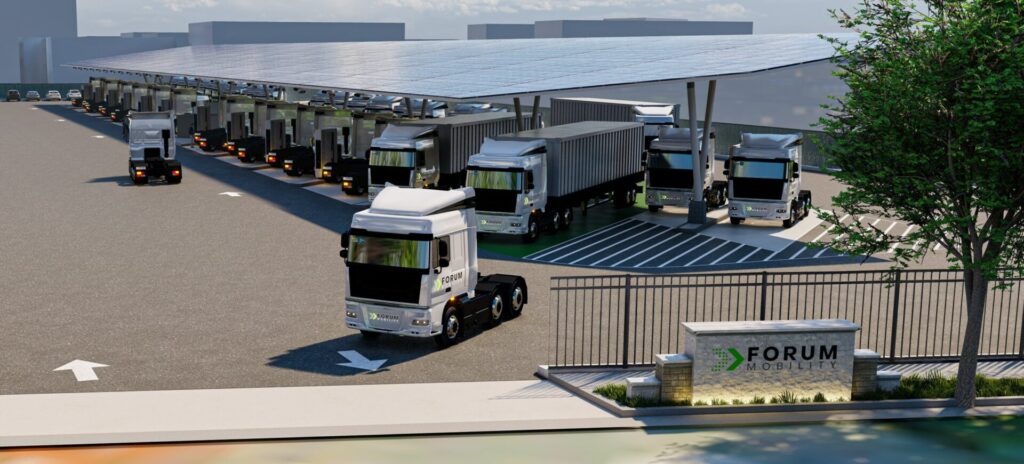
Livermore, California (ZeroRig.com) – Plans for large truck charging stations are increasing in size and frequency ever since the State of California passed their Advanced Clean Fleets rule, which will require all fleets to operate zero-emission vehicles by 2036.
Forum Mobility’s new station will be able to support 96 simultaneously charging heavy-duty trucks and offer all of the comforts of a high-end truck stop. The station will be located in Livermore, which rests on the boundary between the San Francisco Bay Area and Central California. The project costs an estimated $20M and will be available in summer 2024.
The scope of infrastructure development required to satisfy the logistics of powering California’s nearly 1.8 million trucks, should they become EVs, within a little over a decade is staggering. We can expect many more large charging stations to become available in the coming years.
Forum Mobility is expected to roll out more charging station projects, given that they have recently entered into a $400M joint venture to fund charging depots and lease electric trucks as a service.
Powering Truck Charging Stations
Forum Mobility entered into an agreement with Northern California Pacific Gas and Electric (PG&E) to provide the site with 6.5 megawatts of power. Most importantly, PG&E will do so without downtime due to grid upgrades, a major obstacle for most new developments.
Powering truck charging stations is no trivial affair, as some charging stations are expected to draw more power than small towns. Providing ample power to the new charging sites is a complex endeavor, requiring planning with electric utilities which can often take years of development to complete upgrades to the grid required to sustain operations at peak utilization.
Public Support for Charging Development
Forum Mobility is receiving public support in the form of a $4.5 million low-interest loan from East Bay Community Energy (EBCE). The loan will help smooth operational cashflows and allow Forum to charge a lower rate at the charging station, making their offering more competitive and viable as an alternative to existing solutions.
EBCE has invested in other air quality and electrification projects in their territory, which spans across Alameda County and includes both Livermore and the Port of Oakland. The energy organization has been searching for charging depot projects to lend funds to and selected Forum Mobility from a competitive list of developers. The loan is a significant help to Forum’s business operations as financing and capital for charging depots is difficult to source given the youth of the electric trucking industry. Funds are generally searching for well-established business plans, and electric truck depots are still considered a risky investment.
The Recharging Experience at Forum Mobility
Forum is designing the charging depot with two charging speeds in mind; one for fast high-powered chargers for trucks charging during the day and another, slower speed, for overnight charging.
The company does not disclose their expected rates, however, they have stated that they intend to be competitive with the effective price and/or cost of diesel fuel. One advantage Forum Mobility has in their pricing is a deal with PG&E for special EV charging rates that avoid variable demand charges for peak time electricity use. Without such a program, the costs of charging would become unfeasibly large.
Infrastructure as the Limiting Factor
Fundamentally, the limiting factor for the success of a charging depot is the electric grid. Without strong infrastructure, the depot itself will cease to provide the charging it promises. California’s electric grid has been under heavy load for many years, and PG&E will need significant investment in their infrastructure to support the rise of more electric vehicles and truck charging depots in the future. Getting five to ten megawatts of power to a single location demands a lot of the infrastructure surrounding each depot. Forum Mobility’s new Livermore location stands to reap one of the biggest benefits of all; infrastructure needs are already met.