
Fresno, California (ZeroRig) – NextGen Trucking is an educational program that works with high schools to teach senior students about the trucking industry in preparation for a rewarding career. NextGen was present at CALSTART’s Fresno Zero-Emission Ride and Drive and Showcase where we caught up with Dave Dein, the Vice President & Co-Founder, CDL Coordinator/Instructor, and teacher at Patterson High School for an interview on his program and the impact he’s having on the lives of his students and their families.

Dave Dein: Yes. We’re a startup non-profit organization and our mission is to work with highschools from across the US and help them replicate a truck driving program that was created at Patterson High School six years ago. So we provide free resources and support. We don’t sell anything. We’re here to help schools replicate the program and get started with the program.
Wes Barton: How is your program funded?
Dave Dein: In California we operate under something called Career Technical Education (CTE) so we’re eligible for some state funding — it’s actually federal funding through Perkins which goes out to the states and we’re able to leverage some of that state funding to run the program.
Wes Barton: So it’s relatively low or no-cost for the schools to get involved?
Dave Dein: At our school the only cost they have is my salary. Everything else is paid for by the Career Technical Education program.
Wes Barton: That’s fantastic. How many schools are you working with?
Dave Dein: Since we launched the non-profit a year and a half ago we’ve worked with over 150 highschools.
Wes Barton: That’s enormous!
Dave Dein: It’s huge. We’ve noticed a couple things. There’s a lot of demand by schools and there’s a lot of support by industry. We have a lot of industry partners that have come onboard and see the value in this. What we’re doing is creating a pipeline of young well-trained talent. We’re not a traditional truck driving school by any means. And I think what makes us so unique is that we take a more holistic approach to trucking. We look at the entire industry and we see our graduates as being the future leaders in this industry.
And as we all know there are two drivers in truck driving. You have truck drivers and you have professional truck drivers. Right? And it’s night and day difference. And what differentiates the two is really the leadership skills and the mindset. So we invented a program we’ve created called Leadership in Motion and it’s something that happens on a daily basis. We’re constantly going back and referring to those professional driver qualities. We give students the opportunity to play around with them, implement them in their life, and reflect upon them. And what we’re seeing is that the people leaving our program do have a different mindset. People see that. In fact, managers will come up to me and say “I wish our drivers were as mature as your students”. So I think that says a lot.
Wes Barton: Oh that’s fantastic. So how does the program work with the school’s scheduling? Is it a class that you take during the day or is it an afterschool program?
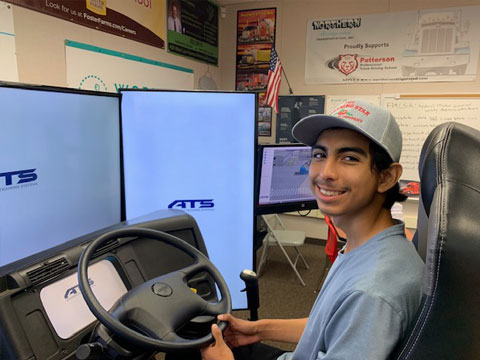
Dave Dein: It’s an elective course. It’s a traditional class. I see students one hour a day. So that’s 180 hours I give them during the year. And then students are also required to come in and do 30 lab hours. A lab is either before school or after school. And this is primarily our simulator training. We have two state-of-the-art driving simulators.

We also incorporate golf-cart backing. We wanted something else that’s hands-on and tangible to teach backing exercises and a golf-cart with a seven-foot utility trailer …
Wes Barton: Oh! It emulates truck backing relatively well?
Dave Dein: It’s much harder. If you can back up a seven-foot utility trailer you can back up a 53-footer no problem. We also teach the air-brake test and pre-trip inspections.
We want our students to have long healthy careers. So we embedded programs that focus on human nutrition, proper lifting techniques, mental health, and Truckers Against Trafficking. So not being a traditional truck driving school I don’t have that time constraint of just flipping seats. I’m not making money. I get paid regardless. So our focus is on having a comprehensive program and doing it the correct way.
Wes Barton: Do your students have to be 16 years old with a driver’s license?
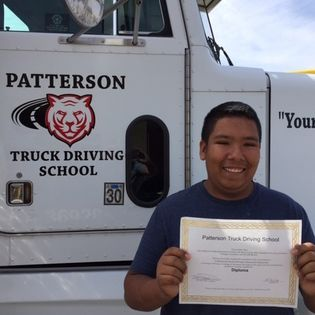
Dave Dein: There’s no requirement to take the class. We ask that we work with seniors only because they’re closer to the age of 18. So we do have several students that take the class that are only 17 years old, but once they turn 18 they’ll apply for their permit. We don’t perform the behind-the-wheel training that’s paid for by our adult education program, so students will enroll in our adult education program. We use that funding to contract with a private truck driving school that does the behind-the-wheel training for us at no cost to the students.
So they get their class-A license for free.
Wes Barton: Could you describe your zero-emission involvement?
Dave Dein: We currently have a one-year program and what we’re looking at doing is developing a two-year program. And part of that two-year program is involving the incorporation of electric vehicle education as far as a driver’s perspective. How do you operate that equipment safely? What are some of the things you’ve got to be concerned about? How do you diagnose and troubleshoot from a driver’s perspective? And that’s one of the things we’ll be incorporating.
Our simulator does actually have the new Freightliner eCascadia truck on it. So the students can at least have the simulation of driving an electric truck. Being here in California, we want to make sure we’re ahead of the game so to speak. We want to use that to educate our students.
Wes Barton: So I noticed there’s another highschool outside. That’s an entirely dedicated program if I understand it correctly. Your program can attach to any school and is kind of modular in that way?
Dave Dein: Yes, this is an elective course. This can be implemented by any school across the US.
Wes Barton: Are you working with any schools outside of California?
Dave Dein: We’ve worked, I think, in almost every state, including Alaska and Hawaii.
Wes Barton: Well that’s very exciting! So you said you’ve only been in operation for a year and a half? Do you have statistics on job placement or is it too early for that?
Dave Dein: I believe that is in the early stage. We’re just currently getting programs up and running. I believe we have 61 programs that are currently in the works of starting. So as soon as those become more finalized we’ll definitely be able to get some data.
Wes Barton: What have you noticed from schools and districts regarding what makes them excited about your program?
Dave Dein: Well it creates realistic opportunities. There’s great demand in the trucking industry and not just from a driver’s perspective but in all the different layers of trucking. So this really is something that young people can see the value in.
The industry is changing so quickly — it’s really about educating people about what this industry is really about — how sophisticated this industry really is and all the opportunities within the industry.
Wes Barton: I noticed you have a long list of non-driving positions in your brochure. I think that’s very exciting. So do you know if any of your students are interested in software and analytics?
Dave Dein: I do! What’s very interesting is that we’re seeing the demographics of people taking the class change over the last six years. The first couple of years were students that maybe struggled in a traditional classroom setting. Last year 30% of my students were students with a 4.0 GPA. So they see the value in taking this class as far as getting a CDL license as a way to help pay their way through college.
Wes Barton: Oh! Interesting!
Dave Dein: But what’s very interesting is that they all came to me last year and they said “Mr. Dein, because of taking this class I now have a passion for trucking.” So they’re still on their path to college to get a degree in computer science, marketing, or engineering, but they all want to come back to trucking in a different capacity.
And if you think about it we should want the best person not only behind the wheel, but in all the layers of trucking. What a great way to get young people to explore the trucking industry.
Wes Barton: You’ve got a leg-up on management!
Dave Dein: We already have companies that are looking at our students and they see the management potential in them already. And they want them to come work for their company because they see that value.
Wes Barton: I think it’s so interesting that you’re getting Advanced Placement students that want to take your elective.
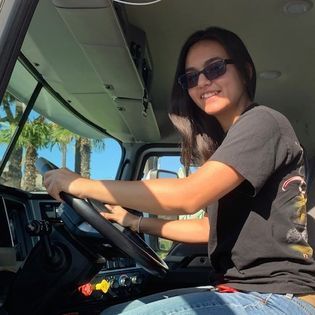
Dave Dein: I think it’s fantastic. And also my female enrollment has gone up. The first few years I had zero female enrollment but last year it was 20%. The industry average is about 7.2%, so we’re above industry average but we’re not satisfied until we hit that 50% mark.
So what we’re doing is we’re very proactive. We know that it’s all based on seat-planning. We go into the elementary schools, we go into the middle schools, I bring in female students to be the role model for the next generation, and we’ve got to start inspiring young females to consider this industry.
Wes Barton: Do you find there are similar trade programs outside of trucking in the schools you’re working with?
Dave Dein: I see some schools that have Career Technical Education programs. Some are focused on healthcare. But we’re the fourth highschool in the United States to do truck driving. The State of Maine has been doing this for about thirty years. But as I said before we take a totally different approach to how we teach it. And that’s what makes us unique.
Wes Barton: I went to highschool in Bakersfield and we had nothing like this at all. I think it would be so interesting to go back in time and take your course.
Dave Dein: It’s really interesting because now we’re seeing the adults that see the value in this program. I’ve had students where the child took the class, got their CDL, and the parent then says “Wow, my son (or daughter) is so successful. I want to get my class-A license”. So they enroll in our adult education class and they get their class-A license. So students are now becoming role models for their parents.
Wes Barton: Do you have any closing thoughts?
Dave Dein: What we have is an industry problem. And I believe it deserves an industry solution. Patterson High School can’t do it by itself. Next Generation Trucking can’t do it by itself. But if we all come together and say “Look, this is valuable, and if we can work together we can create this pipeline, we can change this industry for the better”. And that’s really what our mission is.
Wes Barton: That’s extremely admirable. Thank you for your time, sir.
Dave Dein: Thank you! I appreciate it.
If you’re interested in having your student’s highschool incorporate NextGen Trucking and their program please visit their website at https://www.nextgentrucking.org/